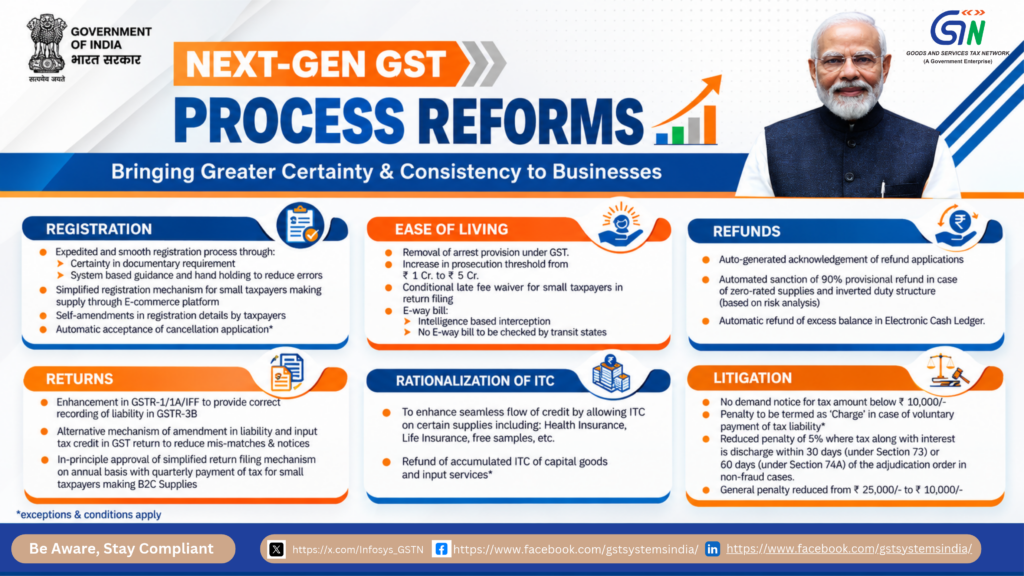
Next-Generation GST Process Reforms
GST Registration Improvements
- Make the GST registration process easier and simpler.
- Introduce a more document-friendly, system-guided process.
- Simplify registration for small e-commerce sellers, including eligible sellers within the stated turnover limit of ₹2.5 lakh per month.
- Provide simplified PAN-based registration for eligible sellers operating across states/territories.
- Allow self-correction of registration details.
- Enable automatic acceptance/approval of eligible applications, subject to the applicable rules.
GST Refund Improvements
- Automatic acknowledgement of refund applications.
- Faster processing of refunds for zero-rated supplies and inverted duty structure cases.
- Risk-based provisional refund of up to 90% within seven days, where eligible.
Provide an electronic-credit-ledger-based refund mechanism for eligible cases involving export of goods.
GST Disputes and Demand Improvements
- No notice for tax amounts below ₹10,000, as described in the infographic.
- Introduce a simplified approach for specified GST liability/return-related cases, including an “as is” treatment where applicable.
- For specified cases, allow payment within 30 days (or 60 days under Section 74A); the infographic states a reduced penalty of 5% for eligible cases.
- Reduce the stated general penalty from ₹25,000 to ₹10,000.
GST Return Filing Improvements
- Introduce GSTR-1A / IFF-related improvements for taxpayers who need to correct details before filing GSTR-3B.
- Provide a more flexible mechanism to correct GST return details and input tax credit (ITC), with applicable time limits and conditions.
Enable simpler annual return reconciliation/filing, including for eligible taxpayers with turnover up to ₹2 crore, as stated in the infographic
Reforms for Service Providers
- Allow eligible Indian service providers serving foreign customers through overseas branches to benefit from the relevant export-of-services treatment.
- Clarify treatment for services supplied to foreign customers where development, repair, maintenance, research or processing work is carried out in India, subject to the applicable conditions.
- Recognise eligible service-provider arrangements under the relevant RBI rules.
- Allow eligible service providers to seek refunds of accumulated input tax credit (ITC), subject to GST law.
E-Way Bill Improvements
- Move towards an e-invoice-based verification process for e-way bills.
- Clarify that the state tax department will not conduct a separate routine verification in the situations described, subject to applicable rules.
- Objective: reduce unnecessary checks and make compliance easier for businesses.
Allow eligible service providers to seek refunds of accumulated input tax credit (ITC), subject to GST law.
Input Tax Credit (ITC) Rationalisation
- Clarify ITC eligibility for health/medical insurance, life insurance and motor-vehicle-related expenses, subject to the applicable GST provisions.
- Rationalise and simplify the ITC refund process for eligible cases.
Objective: reduce unnecessary checks and make compliance easier for businesses.
Ease of Living and Simplification
- Reduce the compliance burden for GST-registered taxpayers.
- Increase the stated monetary threshold from ₹1 crore to ₹5 crore for the relevant provision described in the infographic.
- Reduce late fees for delayed return filing, as applicable.
- Move towards e-way-bill-based verification rather than routine physical checking by state tax authorities, where applicable.
Objective: reduce unnecessary checks and make compliance easier for businesses.
Client statistics
it is keep increasing day by day each sectore wise.
334
Satisfied 5*****
150
Export Units
28
MSMS
56
IP Trade MARK
Would you like to start a service package with us?
You should visit or talk before make any dicision for any services , without test and tryout services so let’s schedule a call.
Jadav & Associates | Company Secretaries | CS Nikunj Jadav